
Table of Contents
Stop Using AI in Your Marketing Strategy (Yes, You Most Likely Are)
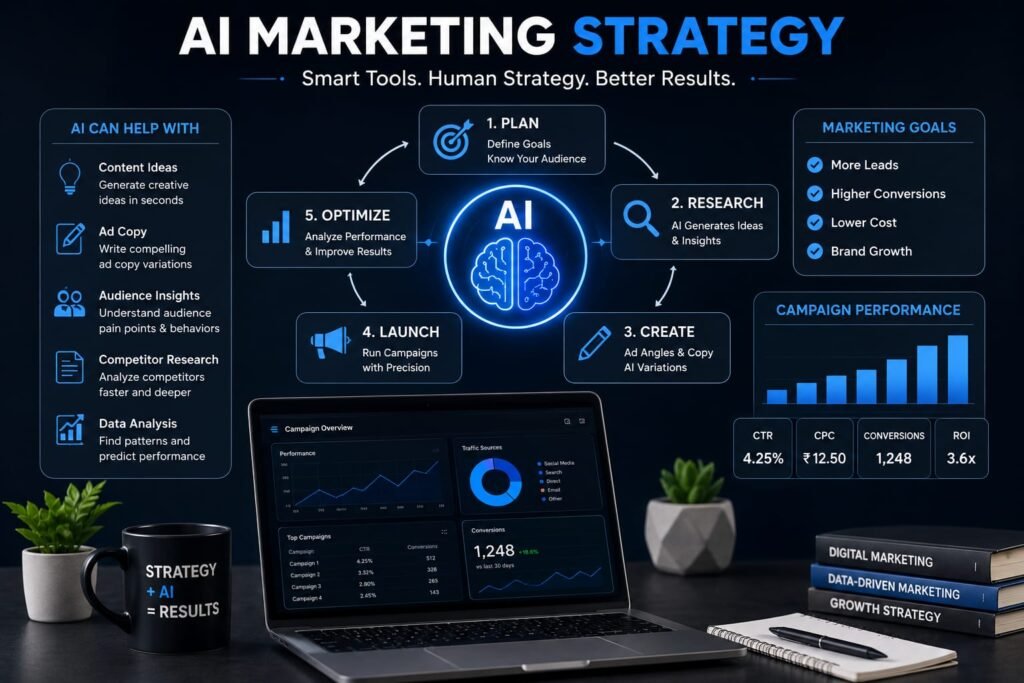
Digital Marketing is not just about posting content or running advertisements. It is about reaching the right audience with the right message at the right time.You know, I see that all the time. After settling in, a marketer launches ChatGPT and requests that it “create an ad campaign for my product.” After that, they enter the findings into Meta Ads Manager, press publish, and watch for conversions that, well, never really happen.
They conclude that “AI doesn’t work for marketing.”
Here’s the thing though—AI absolutely works for marketing. Not the way most people are using it.
However, this is not how the majority of people use it. digital marketing
The actual issue? Instead of using a strategy, people are using the tool. It’s similar to purchasing a Ferrari and driving through traffic to the grocery store. You’re simply not using the Ferrari properly, not the car itself.
The Causes of Everyone’s Outdated Conduct
AI is pervasive and addictive, let’s be honest. Alluring promises include automation, speed, efficiency, and results while you sleep. Every marketing communication you come across brags about the newest AI solution that will “transform your campaigns.” So naturally, marketers start there.
Instead of answering the core question, “What am I actually trying to accomplish?” they become enthused about the technology.
AI just generates pretty-sounding rubbish in the absence of a plan. I’m talking copy that sounds good but doesn’t convert. Audience segments that don’t actually match your customers. Ads that don’t work because no one thought to consider why customer might purchase your goods in the first place.
However, this is typically the case: After spending three hours creating the ideal ChatGPT prompt, a marketer receives fifty ad versions, launches them carelessly, observes their poor performance, and concludes that “AI marketing doesn’t work. Digital marketing
Does that sound familiar?
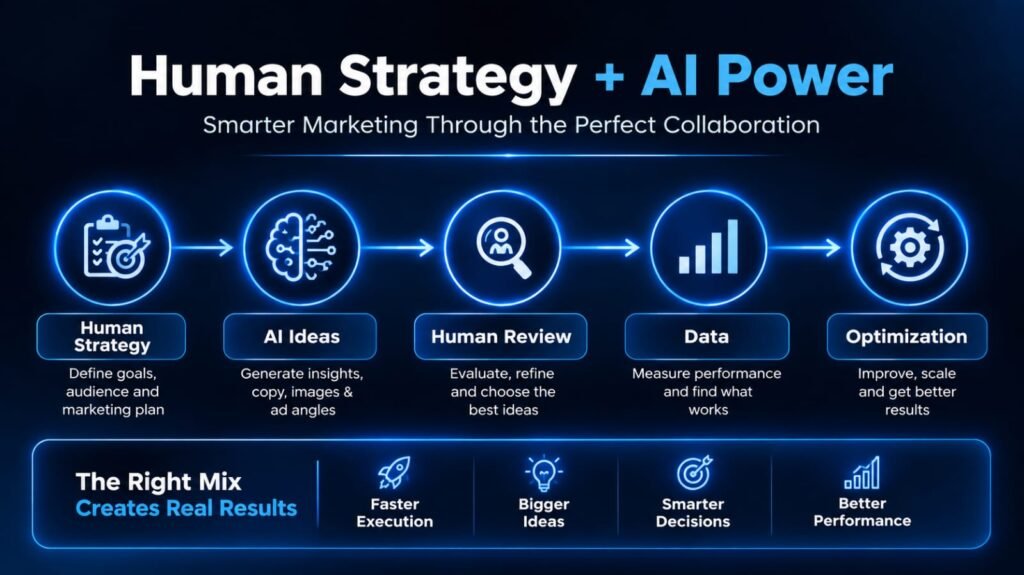
The real scenario is different. The magic happens when you employ AI as a co-pilot rather than the pilot, keep strategic control, and use the technology to enhance your thinking.
AI’s Real Marketing Superpower
Put the hype aside. The actual value of AI isn’t that it’ll replace your thinking. It’s speed.
Consider what a marketer used to do: analyze audience pain issues for an entire day, develop five various ad angles, prepare text, investigate rivals, and perhaps test a few ideas. You’ve only touched the surface of a full workweek.
Now? That same marketer can do all of that in an hour or two. They can explore 20 different angles instead of five. Test 30 ad variations instead of five. Dig into competitor positioning across multiple markets. Examine audience psychology from many angles.
The interesting element is that a smart marketer who employs AI as a thinking partner will consistently outperform a marketer who merely consumes the result. The distinction is in judgment. Human assessment.https://claude.ai/new
You use AI to produce possibilities at scale—dozens of concepts, variations, and perspectives—and then you sift through them using strategic thinking, consumer conversations, and actual market information. Combination? That’s unbeatable.
How to Do This Task Correctly in Five Steps
Step 1: Before Using Any Tools, Create a Plan
Put down the laptop and think for thirty to sixty minutes.
What’s your objective? Are you trying to get people to click to your website? Generate leads? Get people to buy something? Build brand awareness? These aren’t the same thing.
Who are you talking to? Don’t say “marketing managers aged 25-45.” That’s useless. Rather, consider what keeps people awake at night. What problem are they trying to fix? What does success mean to them?
What distinguishes you from others? What sets your product apart from the competition? Use simple language rather than corporate jargon. Is it faster? Cheaper? Greater ease of use? Better customer service?
How will you be able to determine its efficiency? Set your objectives immediately, such as your target cost-per-lead, maximum permitted cost-per-click, or conversion rate. These become the focal point of your optimization.
This boring planning phase? It makes everything else exponentially more effective.
Step 2: Use AI to Explore Options Rather Than Make Decisions
You now present AI. Give Claude or ChatGPT your audience definition and encourage it to consider the issue from several perspectives.
What criticisms may this audience have? What advantages may they miss? What emotional impulses do they find appealing?
AI is fantastic at creating dozens of viewpoints and quickly synthesizing information. It will provide you with ideas that would have required days of manual investigation in only ten minutes.
The crucial point is that these should not be regarded as divine decrees. Treat them like a starting draft. Your job is to filter through them with actual market knowledge. digital. marketing
Do you know customers who have this objection? Have you heard this pain point in sales calls? Does this perspective truly align with what you’ve discovered?
You get the best of both worlds when you mix human market knowledge with AI-generated concepts. Digital marketing
Step 3: Develop and Test Various Ad Angles
| Ad Angle | Focus | Example |
| Time saving | Efficiency | Save time and get more done |
| Cost reduction | Value | Reduce unnecessary marketing costs |
| Exclusivity | Status | Stand out from competitors |
| Pain point | Customer problem | Solve a specific customer problem |
Avoid investing too much on a single advertisement. Develop four or five entirely distinct strategies, each concentrating on a certain advantage or emotional trigger.
Maybe one emphasizes time savings. Another focuses on cost reduction. A third highlights status or exclusivity. A fourth addresses a specific fear or pain point. They should feel genuinely different, not just minor variations on the same message.
Run them through some basic marketing logic: Do they address real audience needs? Do they differentiate from competitors? Are they clear and compelling?
Then—this is crucial—let real data tell you what works. Your gut feeling about which ad will win? It’s probably wrong. That’s why testing matters. Let the market vote.
Step 4: Build Your Campaign (Requires Human Intelligence)
AI assisted with preparation, but you are required for this phase.
Within Meta Ads Manager: Choose your objective (conversions, leads, traffic—they optimize differently). Define your targeting precisely: location, age ranges, interests, behaviors. Connect your ad variations to the right audience segments. Set budgets thoughtfully. These decisions shape everything.
This isn’t the place to autopilot. Your strategic thinking directly determines performance.
Step 5: Make Optimizations Based on Actual Results
| Campaign Result | Possible Problem | What To Check |
| High CPC | Targeting Issue | Audience |
| Low CTR | weak Ad | Copy & Creative |
| High Clicks,Low Conversions | Landing Page Issue | Landing Page |
| High Cost Per Lead | Poor Targeting Or Offer | Audience & Offer |
Once it’s live, forget your assumptions. Watch the data instead. digital marketing
Which audience segment has a way lower cost-per-click? Why? Adjust your targeting.
Which ad variation has double the click-through rate? What makes it work? Apply those insights elsewhere.
Does your conversion rate fall short of what you anticipated? Is it a targeting issue, a message issue, or a landing page issue? Debug it.
This isn’t a one-time thing. The best campaigns are living, breathing things. You check them daily, adjust weekly, improve continuously. Real market feedback beats every prediction you’ll ever make.
The Pitfalls That Kill Campaigns
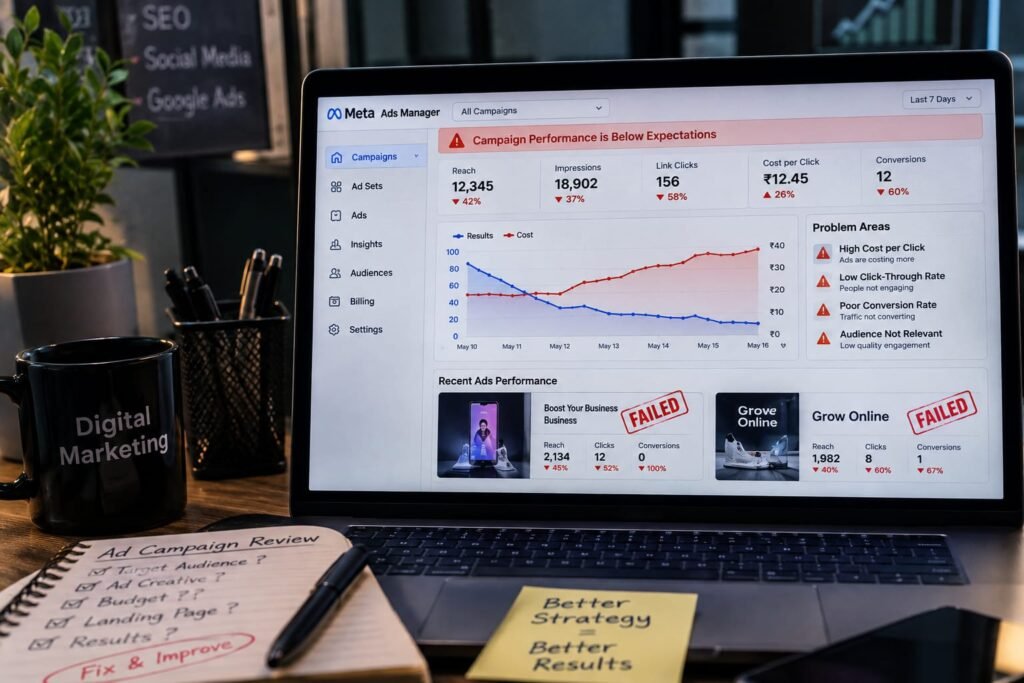
Deploying Unreviewed AI Output
Shipping AI-generated content mindlessly is the biggest error. AI-generated text may sound good, but it may be misleading, tone deaf, or totally out of step with your brand.
Always review. Verify facts. Verify that the tone is consistent with your brand’s voice. Confirm it actually says what you want it to say. Read it as a real customer would.
Implementing Tools Without Strategy digital marketing
This is the meta-pitfall. Teams that skip the planning and research phase, then wonder why their AI-generated campaigns underperform.
AI executes within the parameters you set. But you have to set the right parameters. AI can’t replace strategic thinking. It can only amplify it.
The Bottom Line
AI vs humans is not the future. It concerns the efficient use of AI by humans.
For 2024 and beyond, this is the winning approach: Make a clear plan first. AI may be used to accelerate research and innovation. Use actual data to test. Adapt your iterations to what you discover. AI should be viewed as your co-pilot rather than your pilot. The thinking is done by you. Let AI handle the labor-intensive tasks. Make decisions based on data. That’s not just better marketing. That’s how you actually compete.